
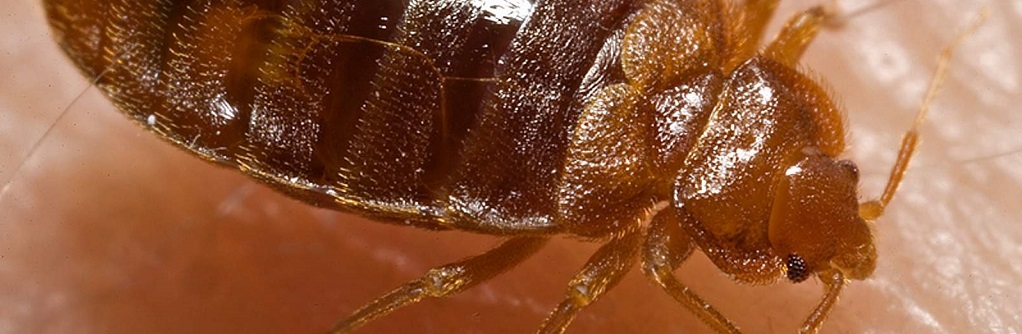
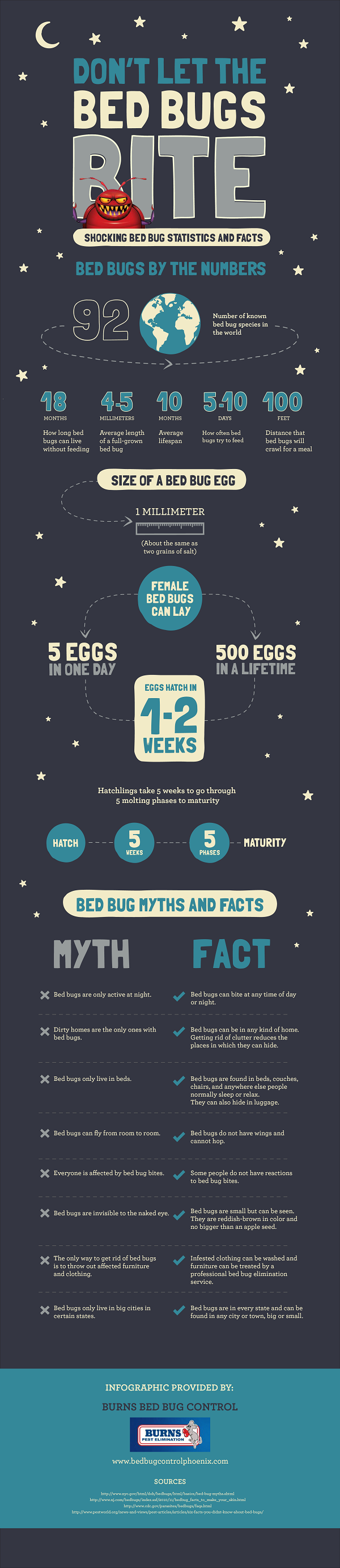
As far as creepy crawlies go, bed bugs are right up there with lice. No one wants to talk about them, but most people have had some sort of encounter with these heeby-jeeby-inducing critters. Unfortunately, bed bugs love to live in the very place that you spend a third of your life. (Yup, we’re talking about your bed) Before you break out in hives at the very thought of these flesh-eating goggas, relax. We’ve found this handy infographic that you can use to equip yourself with everything you’d ever want to know about the lice of linen – bed bugs.
Bed bugs, much like cockroaches, are designed to outlive, outlast and outsmart their hosts.
Tiny in size, a fully grown bed bug is a miniscule four to five millimetres. Their eggs are even tinier – roughly the size of a grain of sand. Because these wily creatures are so incredibly small, they’re often hard to detect – until you break out in bites. Some people don’t react to the bite of a bed bug, although most people will experience the following: small, swollen red bites with a darker centre, often in a group or line; blisters; hives. Bites are often on the face, arms, hand, legs or feet – basically any part of the body that’s exposed while sleeping or sitting near a site of infestation. Many people mistakenly think that bed bugs only feed in the dead of night – in fact, these hungry creatures are active around the clock.
Besides being so small that you’d have to squint to see them, bed bugs are able to go without food for an astounding 18 months.
One of the reasons why bed bugs are so hard to get rid of is due to the fact that they lay dormant for periods of up to a year and a half. This makes them incredibly difficult to detect. If you suspect that your bedfellows are of the bed bug kind, look out for tiny black dots (their droppings) or small smudges of blood (from bites). Bed bugs are most commonly found in facilities that house large groups in close proximity. Hotels, hostels, college residences and apartment blocks are frequently bed bug-housing hot spots.
Bed bugs are gypsy-like in their nature – travelling from place to place using luggage, clothing and linen as their means of transport.
Other hidey-holes include headboards, carpets, mattresses and even furniture. Coupled with their ability to survive sans food for extended periods, bed bugs lay over 5000 eggs in their lifetime. These enthusiastic breeders lay, on average, five eggs a day – which may not seem like a lot, but if your bed is home to 100 bedbugs, there are 500 eggs being laid a day.
The first step in preventing a bed bug infestation is to make sure that your home is kept clean at all times.
By clean, we mean thoroughly hygienic. In order to make your home as unhospitable to these pests as possible, regular vacuuming, including between cracks, crevices and floorboards is essential. Make sure that your mattress is yours and yours only by having it professionally cleaned once a year. If you’re hosting guests of the human kind, be aware that their luggage may be carrying bed bugs, so keep an eye on any luggage or bags that are brought into your house. If you’ve recently been travelling, vacuum and wash (if possible) luggage, carrier bags and clothing that might be home to these pests.
If you suspect that you might have an infestation on your hands, contact a professional pest control provider immediately.
Unfortunately, there’s no DIY solution for bed bug infestations. Besides ensuring that your environment is as clean as possible, infestations do inevitably, occur. In order to ascertain whether you have an infestation or not, as well as to establish the extent of it, it’s advisable to use an experienced pest control company of good repute. They’ll be able to advise you on treatment methods, and then conduct the eradication process in a way that doesn’t put the health and safety of your family at risk.
[hs_action id=”1098″]
Image Credit: Wikipedia

0 Comments