In accordance with the legislation governing workplaces in relation to COVID-19, the employer is required to provide a working environment that is safe and without risk to the health of employees. Steps to eliminate or mitigate any hazard or potential hazard before resorting to personal protective equipment (PPE) must be taken. However, in the case of COVID–19, a combination of controls is required, although the main principle is to follow the hierarchy of controls.
President Cyril Ramaphosa announced on Thursday the 23rd of April 2020, South Africa will be taking a risk-managed approach on lifting the strict lockdown regulations we have experienced over the past couple of weeks. Level 4 lockdown restrictions will apply from Friday 1 May 2020. This means that all essential services plus a limited number of sectors with a low rate of transmission and high economic or social value will be permitted to start operations. This could include certain retail stores (books, stationery, office equipment, sale of alcohol within restricted hours, restaurants and fast food outlets for delivery only), eCommerce and informal traders as well as mines and manufacturing.
With these changes, and those to come into effect at Level 3, 2 and 1, rules will be imposed across all sectors and alert levels for returning to work:
Work from home encouraged
Industries are encouraged to adopt a work-from-home strategy where possible. All staff who can work remotely must be allowed to do so.
Workers above the age of 60 and compromised immune systems
Workers above the age of 60 and those with health issues such as compromised immune systems, HIV/AIDS, TB, diabetes and any respiratory ailments should be offered a work-from-home option or allowed to remain on leave at full pay. These individuals are at high risk of hospitalisation and even death should they contract the Covid-19 virus.
Workplace Protocols
All employers must have protocols in place that include disease surveillance and prevention of the spread of infection:
- Screening of staff on a daily basis for symptoms of Covid-19, including a symptom check as well as temperature assessment
- All employees to use a cloth mask
- Work environment to have sanitisers freely available or handwashing facilities with soap
- Safe transport of employees
- Cleaning of surfaces and shared equipment
- Good ventilation
- Managing sick employees
Monitoring systems must be in place to ensure compliance with safety protocols and identify infections among employees.
How can you provide a safe and healthy environment for your staff and customers that complies with the regulations?
- Ensure that hand sanitisers with an alcohol level no less than 60% is freely available for staff and customers to use
- Hand washing facilities with soap must be available
- Sanitising vehicles used to transport staff, commuters and goods on a regular basis (weekly or fortnightly)
- Disinfecting of offices, warehouses, buildings etc. with a disinfectant that is SABS approved, eliminating 99.9% of all viruses, bacteria, pathogens and microbes.
- Walkway sanitising allowing people into an area to be sanitised with an electrochemically-activated sterilant which is non-toxic
- In conjunction with these measures, thorough deep cleaning is key to ensuring a healthy and safe workplace. Have carpets, upholstery and any fabrics cleaned and sanitised removing microbes, dust etc.
- Issue your staff with cloth facemasks
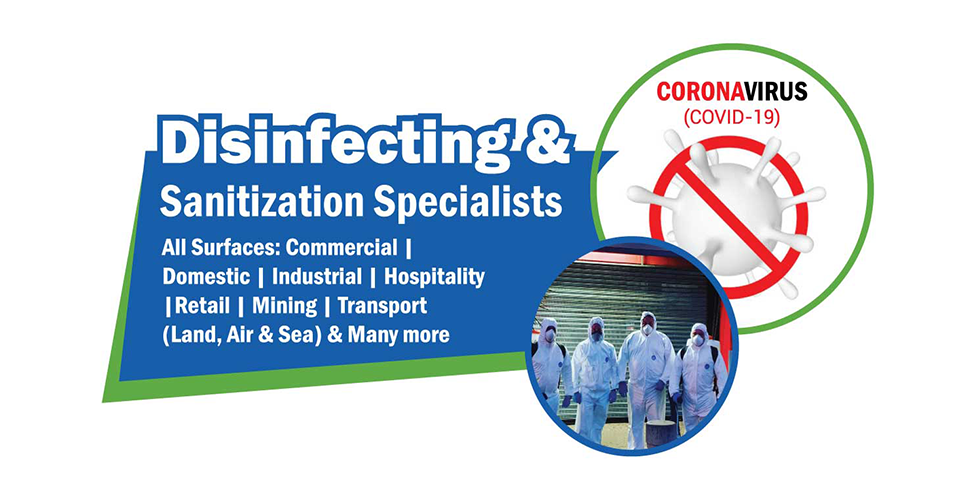
The Specialists in disinfecting offer a highly effective and unique solution for improved disinfection which is SABS approved. It is a form of germicidal shock treatment that bonds to virtually anything and is effective against 99.9% of all microbes that cause illness and odour.
It is ideal for offices, warehouses, medical centres, clinics, surgery areas, hotels, pools, gyms, cinemas, buses, cars and trucks, helping control the spread of viruses, bacteria, fungi, algae, spores and dust mites. READ MORE about our Specialists Disinfection services – Click here
0 Comments